
© 2026 RisUni. All rights reserved.
Emotions · Guide 06
Overwhelmed: several feelings wearing one coat
For when everything asks for you at once and you cannot tell which thing to answer first — so you answer none of them and feel worse about all of them.
Being overwhelmed is not one feeling. It is a queue. Somewhere in it there is worry, some urgency, some guilt, a bit of tiredness, and at least one thing you have been avoiding for three weeks — and because they all arrive at the same time, none of them gets dealt with, and the queue gets a new item: the feeling that you are failing at all of it.
That is why the advice to “just prioritise” lands so badly. Prioritising is itself a task, and it is the exact task the overwhelmed brain cannot do. Trying to sort the queue is what produced the queue.
Part oneWhat it usually looks like
Overwhelm is loud in the body. Tight chest, shallow breathing, an almost physical pressure behind the eyes. A sense that the room is smaller than it was an hour ago. In the mind it goes the other way — everything at once and nothing in particular. You read the same email three times. You open twelve tabs. You start four things and finish none.
The behavioural signature is switching. Not doing nothing — doing a version of everything, badly, in rotation. People describe it as being busy all day and having nothing to show for it, which then reads as a personal failing rather than what it actually is: a person doing the only thing they know how to do when more is arriving than can be handled.
And it usually peaks at the worst possible hour. Overwhelm arrives at 10 p.m. when the house is quiet, because during the day the tasks did the work of keeping it occupied. When the input stops, everything that was waiting gets a turn.
You are not behind because you are slow. You are behind because the queue is longer than one person’s day — and nobody ever sat down and agreed the length with you.
What people do with it
Three things, ordered deliberately from “possible right now” to “possible later”. The first one is the one that matters, because the first one is the only one you can do in the state you are actually in.
1. Narrow it to sixty seconds
One object in your hand, or one breath, whichever is easier to reach. Not to relax — you are not going to relax, and trying will make it worse. The aim is to make the window smaller until the next thing is small enough to do. Sixty seconds of anything is available to you even on the worst evening; a plan for the week is not.
2. Do one thing with your hands
Something with a beginning and an end that nobody is waiting for. Pluck three notes. Brush your hair slowly. Turn a bead on a bracelet between your fingers. Overwhelm is a problem of too much input, so the fix is not another input — it is one output that completes. A small action that finishes is worth more than a large action that is started.
3. Write the queue down, then cross out all but two
Paper, not a phone — a screen adds to the queue. Get everything out of your head and onto one page. Then the only decision you have to make is which two items are genuinely for tonight. Everything else gets an explicit “not tonight”, which sounds trivial and is not: the queue in your head has no closed state. A written queue does.
Why we put these five things in the box
This is the kit where the pieces do the most different jobs, because overwhelm is the feeling that responds worst to any single gesture. The build is one tactile piece, one instrument, one thing to wear, one to hold, and one to read.
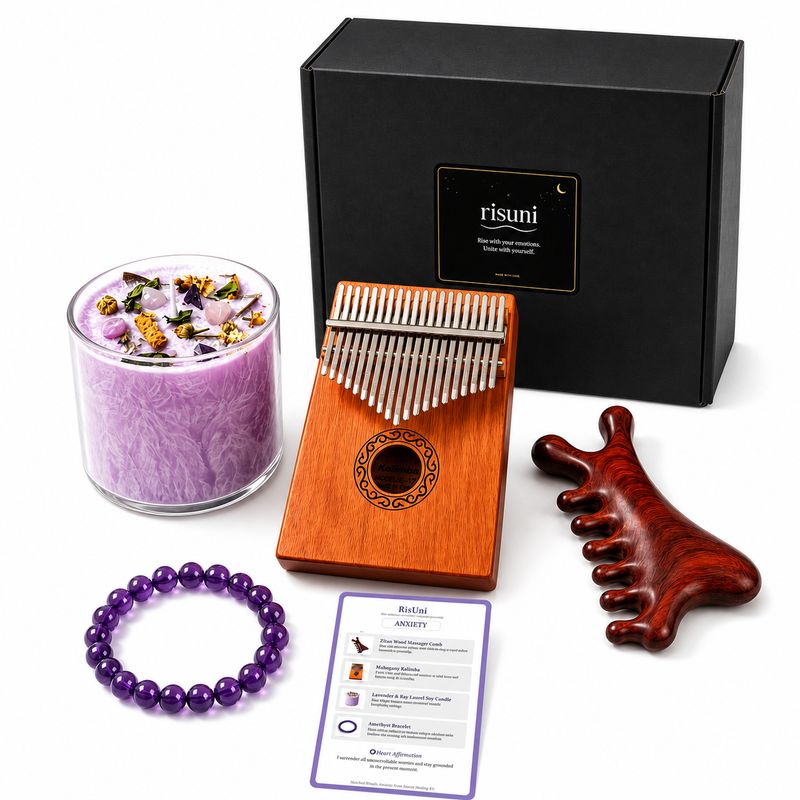
Overwhelmed Comfort · Four-Sense Comfort Kit
$92.00 · five pieces · arrives boxed
- Hands, slowlyHandmade African Padauk Massage Comb — $15.99. Wide-tooth, hand-polished hardwood, heavy enough to feel deliberate. Comes with the ritual inside: scalp to nape, slowly, no hurry.
- Three notes17-Key Hardwood Kalimba — $29.99. No skill needed. Pluck one key, listen to it finish, pluck another. It is the only piece here that makes something.
- Worn dailyNatural Uruguay Amethyst Bracelet, 8 mm — $47.90. Cool, even beads you can turn with a thumb when the day speeds up.
- Something to holdNatural Amethyst Thumb Stone — $11.99. 40 mm, heart-shaped, sized for a pocket. The smallest piece, and the one that travels.
- Something to readOverwhelmed Comfort Card — a short printed note. One instruction, and it is deliberately a small one.
Two practical notes. The comb is the cheapest piece in the kit and often the most used, so if you only want one thing, that is the one we would point you at. And the kalimba sounds like more of a commitment than it is — you do not play it, you pluck single notes and let them finish, which is a different activity with a much lower entry price. All five are also sold separately: $15.99, $29.99, $47.90, $11.99.
The one thing worth remembering
Overwhelm is a temporary state, not a character assessment. Nobody has ever been unable to cope with their life; they have been unable to cope with it at that rate, that week, with that much of it arriving at once. That is a load problem before it is a coping problem — which means the answer is usually subtraction, not effort.
So subtract one thing tonight. Not two, not the whole list — one. Then do one small thing that finishes, and let the rest be tomorrow’s problem, because tomorrow has a full day in it and tonight does not.
This guide describes what overwhelm is usually like and what people do with it. It is not professional advice, and we make no claim about what anything here will do for you. If the feeling does not lift, or if it comes with a fear that keeps you out of ordinary days, please talk to a doctor.