
© 2026 RisUni. All rights reserved.
Emotions · Guide 02
Anger: a boundary that got crossed
For the heat that has nowhere to go, and the guilt that usually arrives right behind it. Anger is information before it is a problem — the difficulty is what to do with the first ten minutes.
Anger is the fastest feeling there is. It arrives before the thinking part of you has finished its sentence, which is why so many people end up apologising for something they said in the first four seconds.
It is also the feeling most people are least honest about. Ask a room who is angry and almost nobody raises a hand. Ask the same room who is tired and every hand goes up. Fatigue is respectable; anger reads as a character flaw. So it gets compressed, and compressed anger does not disappear — it leaks. Into the tone you take with the person who did not cause it. Into the gym. Into the third glass. Into a jaw that aches on Sunday morning for no reason you can name.
Part oneWhat it usually looks like
Anger is usually accurate about one thing: that something was not fair, or was not allowed, or was not seen. The energy is real. It exists for a reason, and the reason is usually a boundary — a line that you did not know you had until somebody walked through it.
What it is usually wrong about is the target. The full force lands on whoever happens to be standing nearest. The person who cut you off in traffic gets a reaction that belongs to your manager; your partner gets a reaction that belongs to a supplier who never answered your email.
In the body it is unmistakable. Heat in the face and chest. A pulse you can hear. Hands that want to close into fists. A sudden, almost physical urge to move — to stand up, to leave, to say the thing you have been not saying for months.
Then comes the second wave, and this is the part nobody warns people about: the guilt. You replay it. You decide you are an unpleasant person. You apologise more than the situation requires, which makes the original problem harder to raise next time, because now you have also undermined your own position.
Anger is not the opposite of being a good person. It is the part of you that noticed something, and it got there before you did.
So the question is not how to stop feeling it. It is: what do you do with the first ten minutes, so that the second ten minutes are yours to choose?
Part twoWhat people do with it
Three things people tell us they actually do. All three share one feature: they give the energy a direction that does not end with somebody being hurt by it.
1. Give it a target that cannot be offended
A walk around the block. Stairs, twice. Something on your desk that is built to be hit and can take it. The important detail is not the exercise — it is that the energy gets to finish its movement somewhere harmless. Anger that is physically expressed for ninety seconds and then dropped tends to feel very different from anger that has been held in place for two days.
2. Make one loud sound, then listen
Strike something once that rings, and stay with it until it is silent. One strike, one long fade. This is a good one for the anger that lives in your chest rather than your fists, and it is also the least embarrassing thing on this list to do at a desk. You are not calming yourself down. You are giving the noise somewhere to be that is not inside you and not aimed at a person.
3. Write the sentence and then destroy it
The unfiltered version. The one that would cost you your job, or a friendship. Then tear it into pieces, or delete it. What makes paper work is that it holds the sentence without reacting to it. People often find that the sentence they were most afraid to write turns out to be shorter than they expected — and the actual objection, underneath, is one clear line about a boundary.
Once the first ten minutes have somewhere to go, the boundary itself gets easier to say out loud. Not always kindly, and not always perfectly — but at least on your own terms, and in your own words.
Part threeWhy we put these five things in the box
Anger is a body feeling before it is a talking feeling, so the kit is built around movement, sound and weight — three things that can absorb force without any conversation happening.
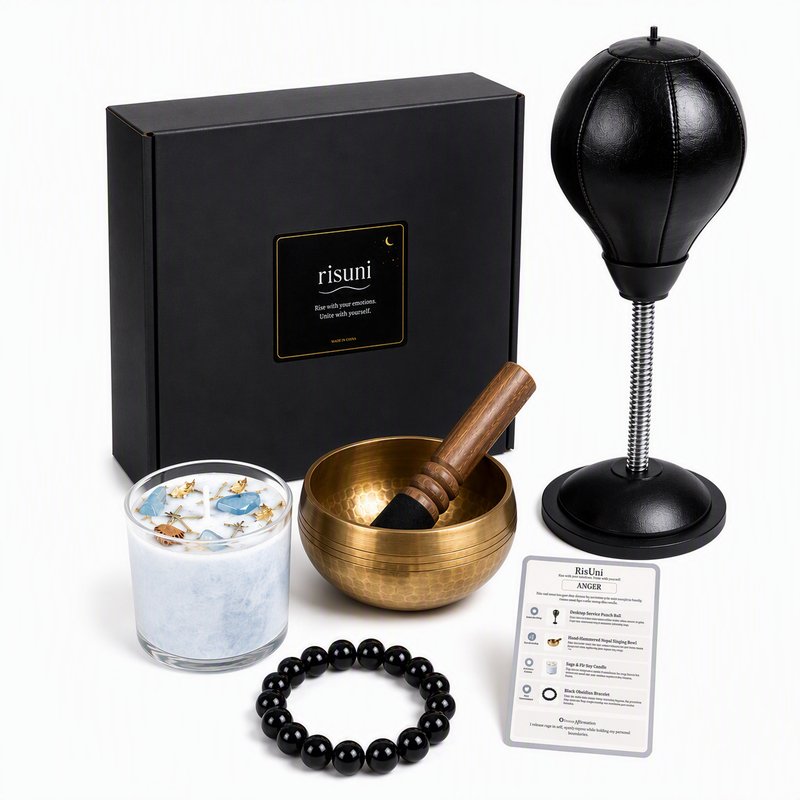
Anger Release · Four-Sense Venting Kit
$91.50 · five pieces · arrives boxed
- Something to hitDesk Buster Desktop Suction Punch Ball — $31.99. Sticks to a desk or wall and springs straight back. For the minute you need it, and then it is just an object on a desk.
- Something to strikeNepal Singing Bowl, 4 in (10 cm) — $34.99. Hand-hammered, rings long after a single strike. One hit, then a fade you can listen through.
- Something denseNatural Mexico Obsidian Bracelet, 8 mm — $24.99. Black obsidian polished to a mirror, heavy for its size, cool against the wrist.
- Something to gripNatural Black Obsidian Thumb Stone — $11.99. 40 mm, heart-shaped, sized so a closed hand can hold it without anyone seeing.
- Something to readAnger Release Comfort Card — a short printed note. Useful on the day you cannot remember why you were upset, only that you were.
The design idea is that there are two kinds of anger and they need different things. Loud anger wants movement — hence the punch ball and the bowl. Quiet anger, the kind that has been sitting for years, mostly wants weight: something dense and cool in your hand that does not argue back. Obsidian is unusually good at that second job because it is heavy in a way that surprises people.
The same honest note as every other kit: the pieces are sold separately ($31.99 / $34.99 / $24.99 / $11.99), and if you already have something at home that takes a hit, use that. The box is for the moment when you would rather not improvise.
One more thing about the guilt
If you are the sort of person who feels bad about feeling angry, you are almost certainly not the person who needs to worry about anger. The people who do damage with it tend never to feel anything about it at all.
The useful move is small: after the heat drops, name the boundary in one sentence. “I cannot take calls after eight.” “Do not speak to me that way.” You do not have to say it well the first time. You just have to stop paying for the same crossed line twice — once in the moment, and once in the guilt afterwards.
This guide describes what anger is usually like and what people do with it. It is not professional advice, and we make no claim about what anything here will do for you. If anger is frightening you, or someone else, please talk to a doctor or a counsellor.